

Investing basics
How to read a 10-K, 10-Q and 8-K
What a company’s annual, quarterly and current reports to the SEC contain, where to find the sections that matter most, and the warning signs worth looking for.
Wenlo EditorialHow we write our guides6 min read
On this page
Why filings are worth reading
US public companies must report to the Securities and Exchange Commission (SEC) on a regular schedule, and whenever something important happens. Those reports are public and free on the SEC’s EDGAR system. They are the company’s own official account of its business, written under legal liability, which makes them more reliable than headlines, social media or even the company’s own press releases.
Filings are long, but you don’t have to read them cover to cover. Knowing what each form is for, and where the key sections sit, lets you find what you need in minutes. The three you’ll meet most often are the 10-K, the 10-Q and the 8-K.
| Form | What it is | When it is filed |
|---|---|---|
| 10-K | Annual report: the full picture, with audited financial statements | Within 60 to 90 days after the fiscal year ends, depending on the company’s size |
| 10-Q | Quarterly report: updated, unaudited financial statements | Within 40 or 45 days after each of the first three fiscal quarters (the fourth is covered by the 10-K) |
| 8-K | Current report: a specific important event | Generally within four business days of the event |
The 10-K: the annual report
The 10-K follows a standard layout of numbered items, so once you know it, you can find your way around any company’s. These are the parts most readers start with:
- Item 1, Business: what the company sells, to whom, how it makes money, its competitors and its main markets. A good place to check that you understand the business.
- Item 1A, Risk Factors: the risks the company itself considers significant. Much of it is standard, but new or newly expanded risks are worth noticing; compare with last year’s list.
- Item 3, Legal Proceedings: significant lawsuits and government actions.
- Item 7, Management’s Discussion and Analysis (MD&A): management explains the year’s results in its own words: what drove revenue and costs, cash and debt, and what it expects. Often the most readable part.
- Item 8, Financial Statements: the audited income statement, balance sheet, cash flow statement and the notes that explain them, plus the auditor’s report.
- Item 9A, Controls and Procedures: whether management and the auditor found the company’s internal controls over financial reporting effective.
Pay attention to the notes to the financial statements. They explain how the company counts revenue, what it owes and when, lawsuits, leases and pension obligations. Many details that matter never appear in the headline numbers.
The 10-Q: the quarterly update
A 10-Q is a shorter version of the 10-K for each of the first three quarters of the fiscal year. Its financial statements are reviewed by the auditor but not audited, and it usually compares the latest quarter, and the year to date, with the same periods a year earlier.
- Part I, Item 1, Financial Statements: the quarter’s numbers and notes.
- Part I, Item 2, MD&A: management’s explanation of the quarter.
- Part II, Item 1A, Risk Factors: often only changes since the 10-K, so anything listed here is new.
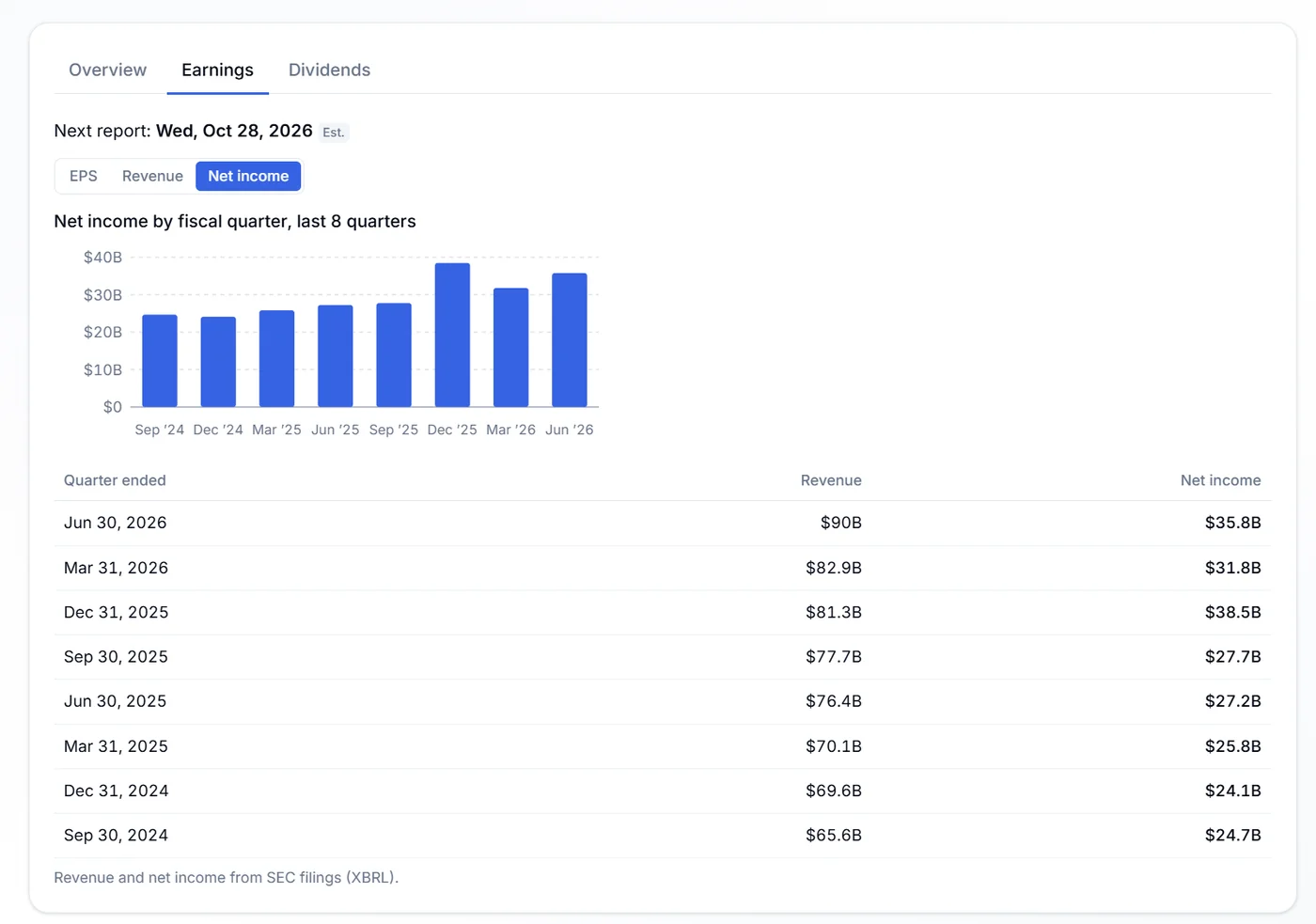
Many companies publish their quarterly results in a press release a few weeks before the 10-Q itself, filed with an 8-K. The press release gives the headline numbers; the 10-Q adds the full statements and notes. How earnings move stocks covers what happens to prices around those reports.
The 8-K: when something happens
An 8-K reports a specific event that shareholders should know about. Each event has a numbered item, so the item numbers tell you what an 8-K is about before you open it.
| Item | What it reports |
|---|---|
| 1.01 | A significant new agreement, such as a major contract, loan or merger agreement |
| 2.02 | Results of operations: usually an earnings release |
| 3.01 | A notice that the stock no longer meets an exchange’s listing rules, or a transfer of listing |
| 4.01 | A change of auditor |
| 4.02 | Previously issued financial statements should no longer be relied on |
| 5.02 | Directors or senior officers leaving or being appointed |
| 5.07 | Results of a shareholder vote |
| 7.01 and 8.01 | Other disclosures and events the company chooses to report |
| 9.01 | Financial statements and exhibits, such as an attached press release |
Most 8-Ks are routine. A few items, especially 4.01, 4.02 and 3.01, deserve a careful read whenever they appear.
Warning signs worth looking for
None of these proves something is wrong, but each is a reason to read more closely:
- A restatement (8-K Item 4.02, or a 10-K/A amending an earlier report): past numbers were wrong enough to correct.
- A material weakness in internal controls (Item 9A): the company or its auditor found a significant gap in how the numbers are produced.
- “Going concern” language: the auditor or management has substantial doubt that the company can keep operating for the next year without new money.
- A late filing notice (Form 12b-25, shown as NT 10-K or NT 10-Q): the company needs more time to file.
- Auditor changes and senior finance departures, especially several in a short time.
- Profit without cash: net income that keeps growing while cash from operations doesn’t.
- Receivables growing faster than sales: customers may be taking longer to pay, or sales may be counted early.
Example
Receivables against revenue
A hypothetical company’s revenue rose 10%, from $500 million to $550 million. Over the same year, the money customers owed it at year end (accounts receivable) rose 40%, from $50 million to $70 million.
One way to compare them is days sales outstanding: receivables ÷ revenue × 365. It went from $50 million ÷ $500 million × 365 = 36.5 days to $70 million ÷ $550 million × 365 = 46.5 days. Customers are taking about ten days longer to pay. There may be a good reason, such as a new large customer on longer terms; the MD&A and the notes are where to look for it.
Finding filings on Wenlo
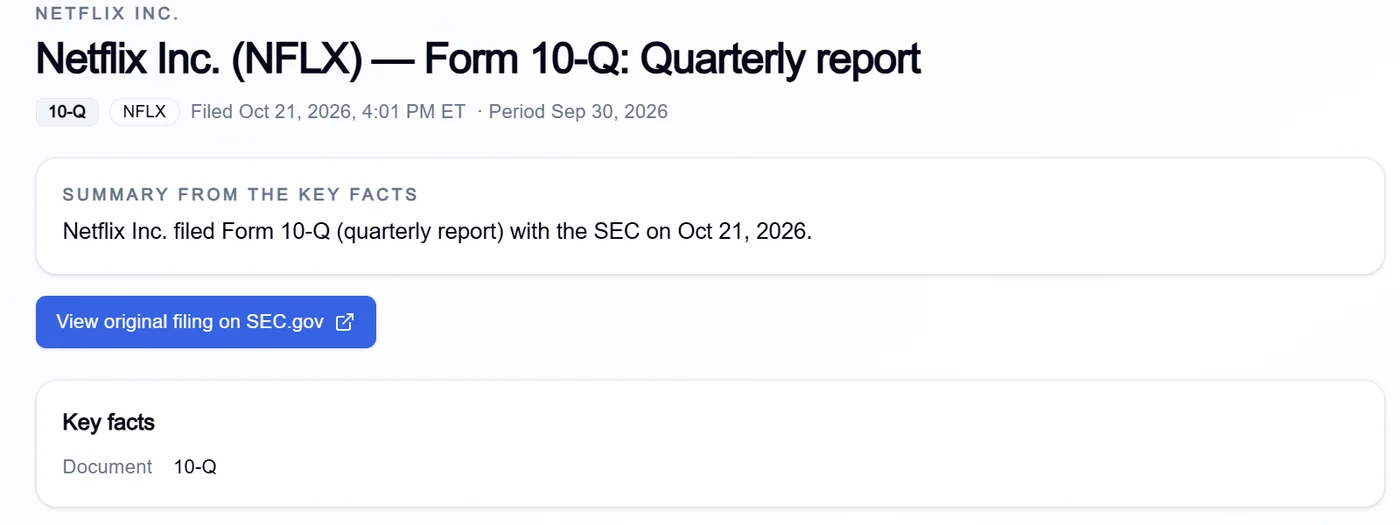
Each ticker page has a news and filings card listing the company’s latest SEC filings, each with its form badge (10-K, 10-Q, 8-K and others). Market news lists recent filings and press releases across large US companies, and you can show filings only or search by company or ticker.
Each filing has its own page on Wenlo with what was filed, key facts and, for many, a short AI-generated summary, plus a button to open the original on SEC.gov. Summaries can miss details or make mistakes; the filing itself is the official record, so read the original before relying on anything important.
A reading routine
- Start with the business (10-K Item 1) so you know what the numbers describe.
- Read the MD&A for management’s explanation, then check it against the financial statements.
- Compare risk factors with last year’s and look for what is new.
- Check cash flow alongside profit, and receivables alongside revenue.
- Skim the 8-K items between reports, and read closely when you see an auditor change, a restatement or a listing notice.
Filings won’t tell you what a stock will do next, and reading them is no guarantee against losses. They do give you the company’s own account of how the business is doing, in a standard format that is the same for every US public company.
Try it with real numbers
Open the latest filings on Wenlo, pick a recent 10-Q or 8-K, and compare its summary with the original on SEC.gov.