

Investing basics
ETFs vs mutual funds vs index funds
An index fund is a strategy; ETFs and mutual funds are two ways to package one. How they differ in trading, costs and taxes, and the questions to ask when you compare two funds.
Wenlo EditorialHow we write our guides6 min read
On this page
Not three separate things
These three terms are often listed side by side as if they were alternatives, but they answer two different questions:
- ETF or mutual fund describes how a fund is packaged: how you buy and sell it, when it is priced and how it is usually taxed.
- Index fund or actively managed fund describes what the fund is trying to do: copy a published index, or have a manager pick investments to try to beat one.
So an index fund can be an ETF or a mutual fund. Many large fund companies offer the same index strategy both ways. And an ETF can be actively managed. Once you separate the wrapper from the strategy, comparing funds gets much easier. If you’re new to ETFs, start with What is an ETF?.
The strategy: index or active
An index fund holds the investments in a published index, such as a list of the largest US companies, in roughly the same proportions. It doesn’t try to pick winners, so it needs no team of analysts, and it trades only when the index changes or when money comes in or goes out. That is why index funds are usually among the cheapest funds to own.
An actively managed fund has a manager or team choosing what to buy and sell, aiming to do better than a benchmark or to reduce risk. You pay for that work through a higher fee. Some active funds beat their benchmarks in a given period; many don’t, especially after fees, and past success is no guarantee it will continue.
Index funds come with their own trade-off: you get the index’s result, good or bad, minus a small fee. Many popular indexes weight companies by size, so the largest companies can make up a big share of the fund. That is worth knowing if you also own those companies directly.
The wrapper: ETF or mutual fund
| ETF | Mutual fund | |
|---|---|---|
| How you trade | On an exchange, through any brokerage account, like a stock | With the fund company, or through a broker that offers it |
| Price you get | The market price at the moment you trade | The net asset value (NAV) worked out after the market closes |
| Minimum | One share, or less with fractional shares | Often a set dollar amount for the first purchase |
| Trading costs | The bid-ask spread; often no commission | No spread; some funds or brokers charge sales loads or transaction fees |
| Automatic investing | Depends on the broker | Widely available, in exact dollar amounts |
| Capital gains payouts | Usually rare | More common, especially in actively managed funds |
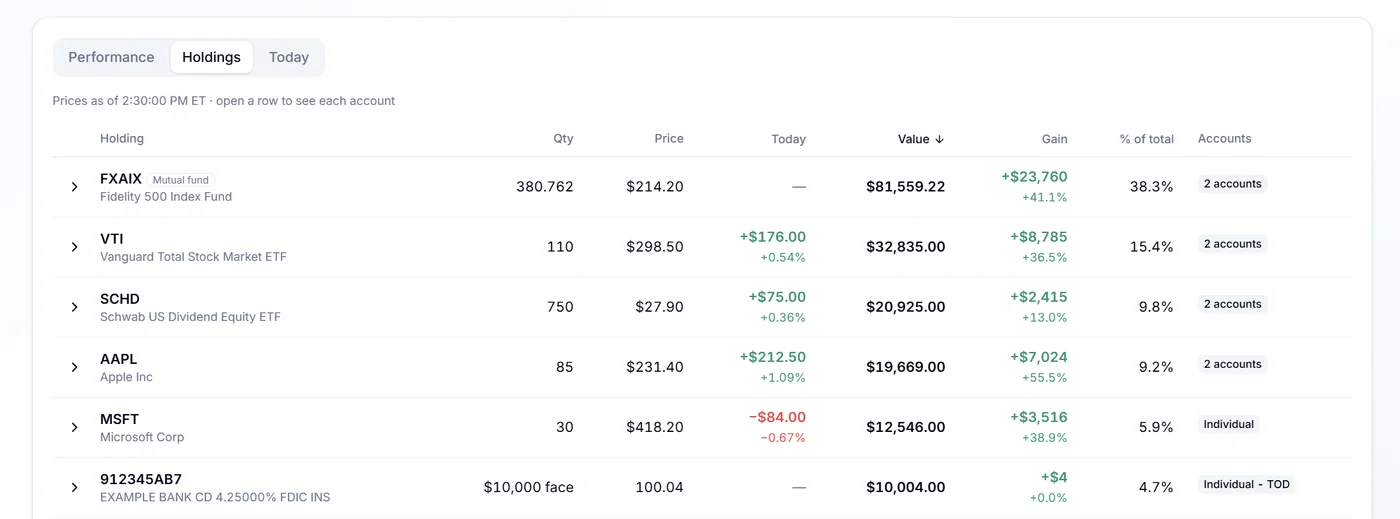
A mutual fund is priced once a day. If you place an order before the fund’s cutoff, usually the 4 p.m. ET market close, you get that day’s NAV; after the cutoff, you get the next day’s. You won’t know the exact price when you place the order. With an ETF, you see the price as you trade, and you can use a limit order to control it, but you also pay the spread. On Wenlo, a mutual fund’s ticker page shows its NAV from the last close rather than a live price.
Costs: the expense ratio and the rest
Every fund charges an expense ratio: a yearly fee, as a percentage of what you hold, taken out of the fund’s value bit by bit. Broad index funds, in either wrapper, are often among the cheapest; specialized and actively managed funds usually cost more. Exact fees vary from fund to fund and change over time, so check the fund’s own page.
Example
A fee gap over 25 years
Two funds hold similar investments that grow 6% a year before fees (a hypothetical figure, not a forecast). One charges 0.10% a year, the other 1.00%. On $25,000, that is about $25 a year against about $250 in the first year.
After 25 years, the $25,000 grows to about $104,795 in the 0.10% fund and about $84,659 in the 1.00% fund: a gap of roughly $20,140, because fees are taken every year from a growing balance.
Mutual funds can carry other costs as well. A sales load is a commission paid when you buy (front-end) or sell (back-end). A 12b-1 fee is an ongoing marketing and distribution fee included in the expense ratio. The same fund may come in several share classes with different loads and fees. ETFs don’t have loads, but you pay the spread each time you trade, and a thinly traded ETF can trade a little above or below the value of its holdings.
Taxes, in general terms
In a taxable US account, you owe tax on a fund’s dividends each year, and on any gain when you sell. Funds also pass on capital gains distributions: when a fund sells investments at a profit, it generally has to pay those gains out to shareholders, who owe tax on them even if they never sold a share.
ETFs tend to make fewer of these payouts. When large investors cash out of an ETF, the fund can usually hand them the underlying investments instead of selling them for cash, which avoids realizing gains. A mutual fund that has to sell investments to pay departing shareholders can realize gains that everyone remaining shares. Index mutual funds trade less than active ones, so they often make modest payouts, but it varies.
Inside retirement accounts such as IRAs and 401(k)s, these differences generally don’t matter year to year. This is a general description, not tax advice; the rules depend on the account and on your situation.
How to compare two funds
Whatever the wrapper, the same handful of questions covers most of what matters. The answers are in the fund’s fact sheet and prospectus on the provider’s website.
- What does it hold? Read the index or strategy, the number of holdings and the top ten. Two funds with similar names can hold quite different things.
- What does it cost? Compare expense ratios, plus any loads, transaction fees or typical spreads.
- How closely does it track? For an index fund, compare its return with its index over several years. The gap, called tracking difference, should be close to the fee.
- How big and how liquid is it? Very small funds are more likely to close. Thinly traded ETFs can have wide spreads.
- How does it fit with what you already own? A second fund that holds the same large companies adds little diversification.
Example
Overlap between funds
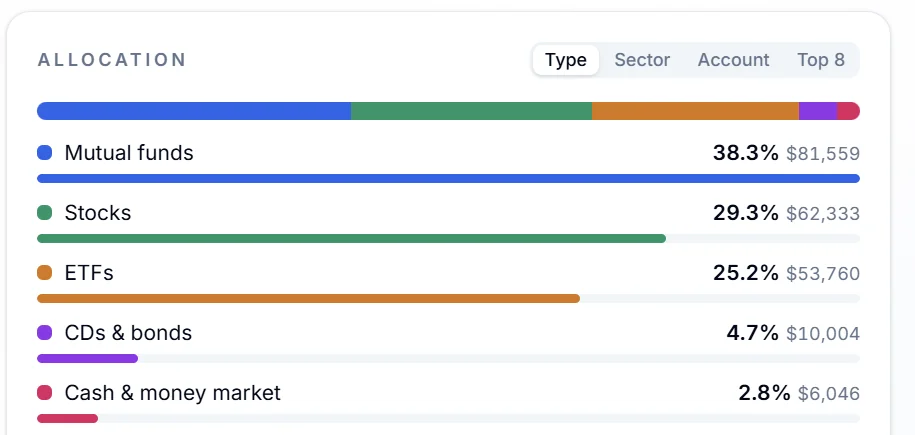
Suppose you hold a broad US stock index fund and add a large-company growth fund. If the growth fund’s ten largest holdings are also the broad fund’s ten largest, much of your new money goes to companies you already owned. Your portfolio becomes more concentrated in them, not more diversified.
Key takeaways
- “Index” is the strategy; “ETF” and “mutual fund” are the wrappers.
- ETFs trade all day at market prices; mutual funds trade once a day at NAV.
- Small differences in yearly fees compound into large differences over decades.
- In taxable accounts, ETFs usually pass on fewer capital gains than mutual funds.
- Compare holdings, costs, tracking and overlap, not just names and past returns.
There is no single best wrapper. Plenty of investors hold both: mutual funds in a workplace plan, for example, and ETFs in a brokerage account. What tends to matter most over time is what the fund holds and what it costs.
Try it with real numbers
Use the screener’s ETF filter to browse funds side by side, or try the sample portfolio to see how holdings break down by type, sector and account.