

Investing basics
Diversification and position sizing: why one stock shouldn’t be 40% of your portfolio
How concentration magnifies losses, why owning many stocks that move together isn’t the same as diversifying, and simple sizing rules of thumb investors use to keep any one holding in proportion.
Wenlo EditorialHow we write our guides6 min read
On this page
What one bad result does to a portfolio
Every company can disappoint: a failed product, a lawsuit, an accounting problem, a competitor that gets ahead. When a stock is a small part of your portfolio, a disappointment like that hurts but doesn’t decide your year. When it is a large part, it can.
Example
Forty percent in one stock
Suppose 40% of a hypothetical portfolio is in one stock and the other 60% is spread across a broad fund. The stock falls 50% after bad news while the fund is flat. That single holding knocks 40% × 50% = 20% off the whole portfolio.
Getting back to where you started then takes a 25% gain on everything, because a portfolio that has fallen from $100 to $80 needs $20 more, which is 25% of $80. Losses and the gains needed to recover them aren’t symmetric: a 50% loss on its own needs a 100% gain to recover.
Compare a portfolio of 20 holdings of 5% each. Even if one company went to zero, the portfolio would lose 5%. Diversification means spreading your money so that no single result can do outsized damage. It doesn’t make losses impossible; it makes them less dependent on any one thing going wrong.
Two kinds of risk
It helps to split risk into two parts:
- Company-specific risk: things that hit one business, such as a recall, a lost contract or a failed drug trial. Owning many different companies reduces this risk, because one company’s bad news is diluted by everyone else’s.
- Market risk: things that hit almost everything at once, such as recessions, interest rate changes or a financial crisis. Owning more stocks doesn’t remove this risk. In a broad sell-off, a well-diversified stock portfolio still falls.
That second point is often misunderstood. Diversification smooths out the surprises from individual companies; it doesn’t protect you from the market as a whole. Investors who want less market risk usually look at how much they hold in stocks at all, compared with bonds or cash, which is a separate decision.
Correlation: owning many things that move together
Correlation measures how closely two investments move together, on a scale from −1 to +1. Near +1, they tend to rise and fall together. Near 0, their moves are mostly unrelated. Below 0, one tends to rise when the other falls. Diversification works best when holdings aren’t highly correlated.
Owning ten stocks sounds diversified, but if all ten are in the same industry, they often react to the same news: a change in regulation, a shift in demand, a rise in costs. They can fall together. Common sources of hidden concentration include:
- One sector or theme: several companies that depend on the same customers, technology or commodity price.
- Overlapping funds: a broad index fund and a large-company fund often hold the same biggest names, so owning both concentrates rather than spreads. ETFs vs mutual funds vs index funds covers how to check overlap.
- The same stock in several accounts, or held directly and also as a top holding of a fund you own.
- Your employer’s stock: your job and your savings then depend on the same company.
Correlations also change. In a sharp market fall, assets that usually move independently can drop together, so diversification tends to help less in a crisis than it does on average.
How concentration creeps in
Many concentrated portfolios didn’t start that way. A stock that does very well grows to dominate the portfolio on its own.
Example
A winner that grows
A stock starts at 10% of a $100,000 portfolio: $10,000, with $90,000 in everything else. Over a few years it triples to $30,000 while the rest stays at $90,000. It is now $30,000 ÷ $120,000 = 25% of the portfolio, without a single new purchase.
That is a nice problem to have, but it changes the risk. Rebalancing means periodically trimming holdings that have grown beyond the share you intended and adding to those that have shrunk. Some investors rebalance on a calendar, such as once a year; others when a holding drifts a set amount away from its target. In a taxable account, selling a winner can mean paying tax on the gain, which is one reason people rebalance with new money where they can.
Position-sizing rules of thumb
Position sizing is deciding how much to put into any one holding. There is no correct answer for everyone, but a few common approaches show how investors think about it. These are illustrations, not recommendations:
- A cap per holding. Some investors set a maximum share for any single stock, such as 5% or 10% of the portfolio, and trim when a holding grows past it.
- Equal weights. Splitting money evenly across holdings keeps any one from dominating, and makes drift easy to spot.
- Core and satellite. A large “core” in broad funds, with a smaller portion in individual stocks, so a single company can only affect the satellite part.
- Size by risk, not by conviction. Some traders decide how much they are willing to lose on one position, as a share of the portfolio, and size the position from that.
Example
Sizing from a planned loss
An investor with a $50,000 portfolio decides that one position shouldn’t cost more than 1% of it, or $500, if things go wrong. They plan to buy at $40 and to sell if the price falls to $36, a risk of $4 a share. That works out to $500 ÷ $4 = 125 shares, a $5,000 position, or 10% of the portfolio.
The plan has a gap, literally. If bad news sends the stock straight from $40 to $30 overnight, the sale happens around $30, and the loss is $10 × 125 = $1,250, or 2.5% of the portfolio. Planned exits limit losses in normal trading, not in every case.
Seeing your own concentration
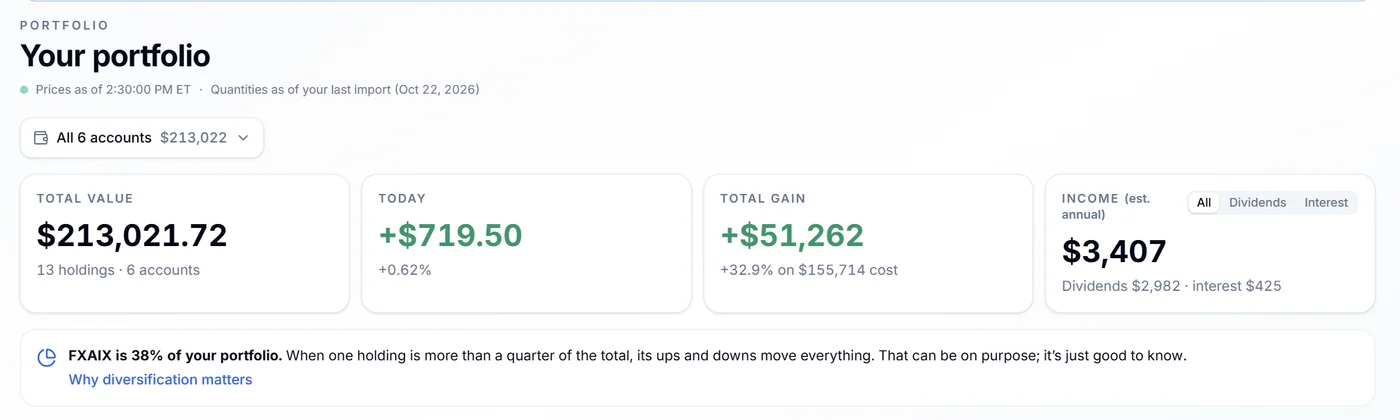
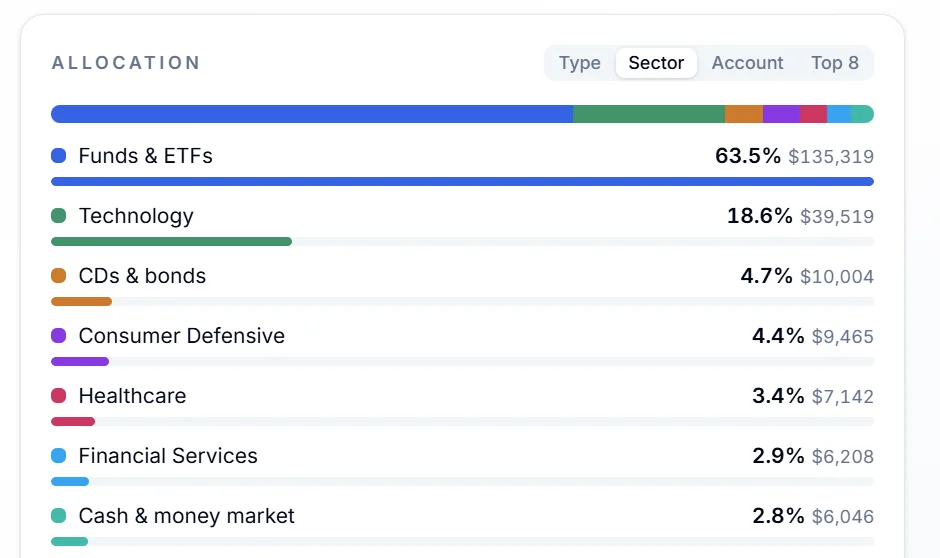
It is hard to judge concentration when your money is spread across several accounts. Wenlo’s portfolio combines imported accounts in one view. Its Allocation card breaks holdings down by type, sector, account and top holdings, and a note appears when any single holding is more than a quarter of the accounts you are looking at. That note isn’t a warning to sell; sometimes a large position is deliberate. It is a prompt to check that the size matches what you intend.
Risk
Diversification has limits
Spreading money across many holdings reduces the damage from any one company, but it doesn’t prevent losses when the whole market falls, and it can’t turn a poor investment into a good one. Very wide diversification also means no single success will lift your returns much.
Key takeaways
- Concentration magnifies single results. A 50% drop in a 40% holding costs the portfolio 20%.
- Diversification reduces company-specific risk, not market risk.
- Count correlations, not tickers. Ten stocks in one industry can behave like one bet.
- Winners drift upward in weight. Rebalancing keeps sizes close to what you intended.
- Decide sizes in advance, with a cap, equal weights or a planned loss, and remember that gaps can exceed the plan.
How much concentration is right depends on your goals, your time horizon and how much loss you could live with. Knowing your actual exposure is the starting point for that decision, and a licensed professional can help you weigh it against your own situation.
Try it with real numbers
Try the sample portfolio to see how its holdings break down by type, sector and account in the Allocation card. No account needed.