

Investing basics
Dividends explained: yield, key dates, DRIP and taxes
How dividends are declared and paid, what the ex-dividend, record and payment dates mean, how trailing and forward yield differ, how reinvestment works, and the general difference between qualified and ordinary dividends in the US.
Wenlo EditorialHow we write our guides7 min read
On this page
What a dividend is, and what it isn’t
A dividend is a payment a company makes to its shareholders, usually in cash and usually out of profits. In the US, most dividend-paying companies pay quarterly; some pay monthly, twice a year or once a year. Many companies, especially younger ones, pay nothing and reinvest their profits in the business instead.
A dividend isn’t a bonus on top of the stock’s value. The cash leaves the company, so the company is worth roughly that much less afterwards, and the share price tends to adjust. What a dividend does is turn part of your return into cash you can spend or reinvest. Investors who care about the whole picture look at total return: price change plus dividends.
Dividends also aren’t guaranteed. The company’s board decides each payment and can raise, cut, suspend or skip it. The basics of yield and payout ratio are in P/E ratio and dividends, explained; this guide goes into the dates, reinvestment and taxes. The numbers in the examples are hypothetical.
The four dates, in order
| Date | What happens | What it means for you |
|---|---|---|
| Declaration date | The board announces the amount and the other dates | The payment is now scheduled |
| Ex-dividend date | Shares start trading without the right to this dividend | Buy before this date to receive it; buy on or after it and the seller gets it |
| Record date | The company takes its list of shareholders of record | Usually the same day as the ex-date in the US today |
| Payment date | The cash is paid out | It arrives in your brokerage account |
The ex-date and the record date line up because of settlement: a US stock trade becomes official one business day after the trade (called T+1, the rule since May 2024). If you buy on the day before the ex-date, your purchase settles on the record date and you are on the list. If you buy on the ex-date, it settles a day too late.
You don’t need to hold the shares until the payment date. If you owned them before the ex-date, you’ll receive the dividend even if you sell on the ex-date itself. Unusually large special dividends can follow different ex-date rules set by the exchange, so read the company’s announcement when one comes up.
What happens to the price on the ex-date
Example
The ex-date adjustment
A stock closes at $40.00 the day before its ex-date, and the dividend is $0.50 a share. All else being equal, it would open around $40.00 − $0.50 = $39.50 on the ex-date, because new buyers no longer get the $0.50.
Someone who owned 200 shares before the ex-date sees their shares worth about $100 less and will receive 200 × $0.50 = $100 in cash on the payment date. Their total is roughly unchanged, before any tax on the dividend.
In practice, the price moves for many reasons on any given day, so the drop is rarely exactly the dividend. But the adjustment is why buying just before the ex-date to “capture” a dividend rarely works the way people hope. In a taxable account, it can leave you with a tax bill on the dividend and a matching loss in price.
Trailing and forward yield
Dividend yield is the yearly dividend divided by the share price. Sites differ on which “yearly dividend” they use:
- Trailing yield adds up the dividends actually paid over the last twelve months.
- Forward yield takes the latest regular payment and multiplies it by the number of payments in a year.
Example
Same stock, two yields
A $50 stock paid $0.45, $0.45, $0.50 and $0.50 over its last four quarters, after raising its dividend halfway through the year. Its trailing dividend is $1.90, a yield of $1.90 ÷ $50 = 3.8%. Its forward dividend is $0.50 × 4 = $2.00, a yield of $2.00 ÷ $50 = 4.0%.
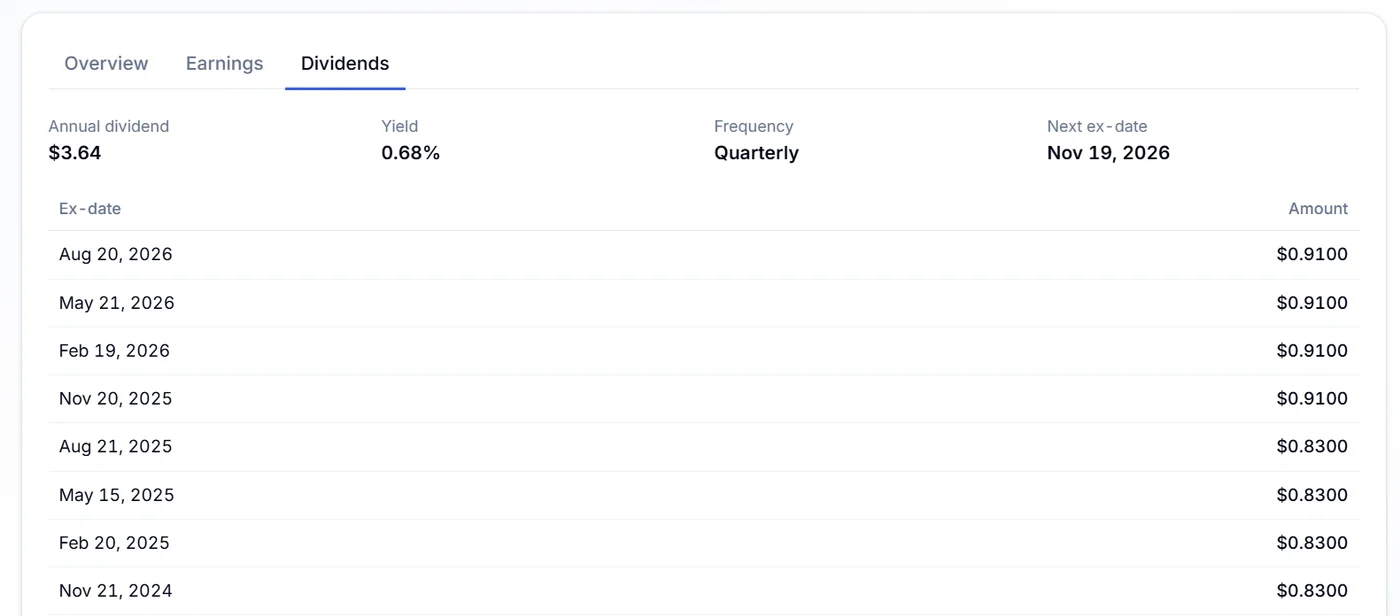
After a raise, the forward yield is higher; after a cut, it is lower. A special one-time dividend can make the trailing yield look unusually high for a year. For a stock on Wenlo, the ticker page’s Dividends tab shows the annual dividend from the last twelve months of payments, the yield, how often the company pays, the next ex-date and the payment history.
Risk
A very high yield deserves a closer look
Yield goes up when the price falls. An unusually high yield can mean the market expects the dividend to be cut. Check the payout ratio (dividends as a share of earnings, or of free cash flow), the company’s recent results and whether the dividend has been cut before.
Reinvesting dividends (DRIP)
A dividend reinvestment plan (DRIP) uses each dividend to buy more shares of the same stock or fund instead of paying you cash. Most brokers offer it as a setting, per holding or for the whole account, often with no commission and with fractional shares, so every cent goes back in.
Example
One reinvested dividend
You own 200 shares and receive a $100 dividend. With reinvestment on, and the stock at $40 on the payment date, the broker buys $100 ÷ $40 = 2.5 more shares. You now own 202.5 shares, and the next dividend is paid on all of them.
Over many years, reinvesting lets dividends compound: they buy shares that pay their own dividends. The trade-off is that you don’t get the cash, and every reinvestment is a new purchase at whatever the price is that day, which adds a new cost basis to track. In a taxable US account, reinvested dividends are still taxable in the year they are paid, even though you never saw the cash.
Qualified and ordinary dividends (US, in general)
This section describes US federal rules in general terms. It isn’t tax advice, rules change, and your situation may differ, so check with a tax professional or the IRS’s own guidance.
- Qualified dividends are taxed at the lower long-term capital gains rates. To qualify, the dividend generally has to come from a US company or a qualifying foreign one, and you must have held the shares for more than 60 days during the 121-day period that begins 60 days before the ex-dividend date.
- Ordinary (nonqualified) dividends are taxed at your regular income tax rate. These include dividends on shares you didn’t hold long enough, and most distributions from real estate investment trusts (REITs) and money market funds.
- Retirement accounts such as IRAs and 401(k)s generally don’t tax dividends each year while the money stays inside the account; the rules for withdrawals depend on the type of account.
Example
The holding period
You buy shares 3 days before the ex-date, collect the dividend and sell 10 days after the ex-date. You held them for about 13 days, well short of the more than 60 days required, so that dividend would generally be taxed as ordinary income.
Your broker reports dividends each year on Form 1099-DIV, with total ordinary dividends and the qualified portion shown separately. Foreign companies’ dividends may also have tax withheld by their home country before you receive them.
Key takeaways
- A dividend is part of your total return paid in cash, not extra money; the price tends to drop by about the dividend on the ex-date.
- Own the shares before the ex-dividend date to receive the payment.
- Know whether a yield is trailing or forward, and treat a very high yield as a question.
- Reinvesting compounds your holdings but is still taxable in a taxable account.
- Whether a dividend is qualified depends on the payer and on how long you held the shares.
Dividends can be a steady part of a portfolio’s return, but a dividend is only as reliable as the business paying it. The company’s earnings and cash flow tell you more about the next payment than the last one does.
Try it with real numbers
Screen for stocks yielding at least 2.5%, then open one and look at its Dividends tab: how often it pays, the next ex-date and how the payments have changed.